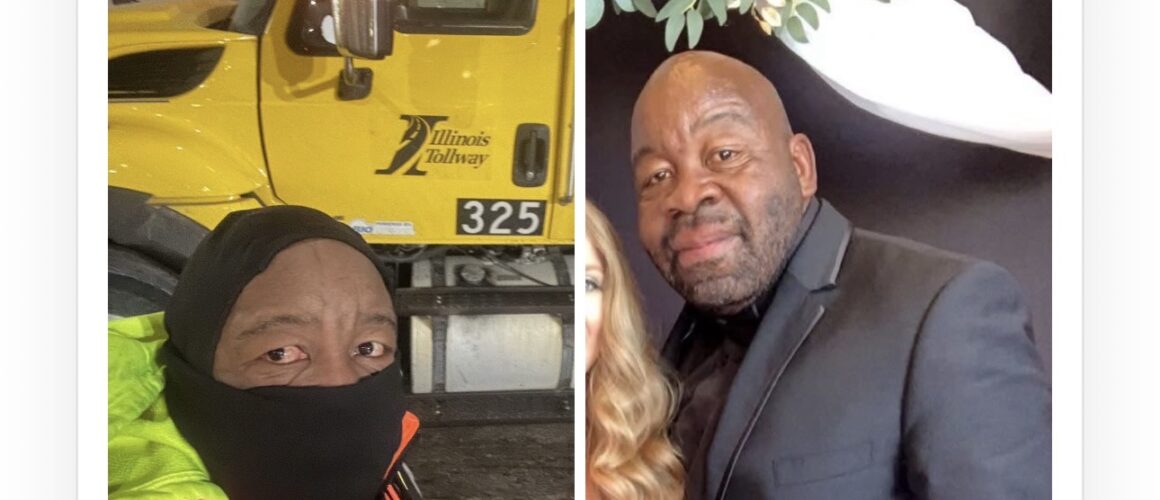
An Illinois Tollway maintenance worker was killed and two others were seriously injured in the early morning hours of Saturday after being struck while performing pothole repair work on Interstate 294 in suburban Des Plaines, Illinois. The tragic incident has sent shockwaves through the Illinois Tollway workforce, the City of Chicago, and the broader community of road workers and transportation professionals who risk their lives every single day to maintain the safety of America’s highways and roadways.
Authorities identified the worker who died as Calvin L. Holley, 52, of Chicago, according to the Cook County Medical Examiner. The crash occurred at approximately 4:26 a.m. near milepost 41.5 on I-294 in suburban Des Plaines — in the pre-dawn darkness of a Saturday morning when most of the region was still asleep and Calvin Holley and his colleagues were out on the highway doing the work that keeps Illinois roads safe for the millions of drivers who travel them every day.
What Authorities Have Confirmed
The crash occurred at approximately 4:26 a.m. on Saturday morning near milepost 41.5 on Interstate 294, also known as the Tri-State Tollway, in the suburban Chicago community of Des Plaines, Illinois. According to authorities, Calvin L. Holley, 52, and two other Illinois Tollway maintenance workers were struck while actively working in the roadway performing pothole repair operations.
The Cook County Medical Examiner confirmed the identity of Calvin L. Holley, 52, of Chicago, as the worker who was killed in the crash. The two surviving workers who were struck in the same incident were transported by emergency medical personnel to a local hospital for treatment. Their identities have not been publicly released, and their conditions had not been publicly disclosed at the time of this publication.
Following the crash, all southbound lanes of I-294 were immediately shut down between Dempster Street and Touhy Avenue as emergency responders, law enforcement officials, and investigators converged on the scene. The full closure of the southbound lanes remained in effect for several hours as the investigation proceeded and the scene was processed. The roadway was reopened to traffic at approximately 11:30 a.m., roughly seven hours after the crash occurred.
The Illinois State Police, which has primary jurisdiction over crash investigations on Illinois interstate highways, is leading the investigation into the circumstances that led to the deaths of Calvin Holley and the injuries sustained by his two colleagues. The investigation is ongoing, and no charges or final determinations of cause had been publicly announced at the time of this publication.
The Illinois Tollway Responds: A Respected and Valued Member
The Illinois Tollway, which operates and maintains the 294-mile network of toll roads serving the greater Chicago metropolitan region, confirmed the death of Calvin L. Holley and released a statement expressing the agency’s grief and honoring his service and sacrifice.
According to the Illinois Tollway, Calvin Holley had been employed as an equipment operator and laborer with the agency for two years. In its official statement, the Tollway described him as a “respected and valued member of the Tollway” who was performing routine roadway safety duties at the time of the crash — duties that are essential to the safety of every driver who travels on Illinois’s tollway system.
The Tollway’s statement painted a clear picture of the nature and importance of the work that Calvin and his colleagues perform every day, often in conditions and at hours that put them at significant personal risk. “Our equipment operator/laborers work on the front line of our 294-mile roadway system, performing duties that include maintaining safe roadway conditions and assisting drivers who were stranded or needed help,” the agency stated. “He was carrying out these duties when he tragically lost his life on the Tri-State Tollway.”
The language of the Illinois Tollway’s statement — describing Calvin Holley as working on the “front line” — is both accurate and important. Road maintenance workers occupy one of the most dangerous positions in the American workforce precisely because they perform essential work in the most dangerous places — on active roadways, often in low-visibility conditions, in proximity to vehicles traveling at highway speeds. They stand between the traveling public and the hazards that would make roads impassable, and they do so with a dedication and professionalism that deserves far greater public recognition than it typically receives.
Governor JB Pritzker Responds
Illinois Governor JB Pritzker responded to the news of Calvin Holley’s death on social media, calling the incident “heartbreaking” and urging the public to keep the victims of the crash in their prayers and thoughts.
“May their memory be a blessing, and may we come together to pray for the injured,” Governor Pritzker wrote in his statement. “Remember to slow down and keep our workers safe.”
The Governor’s response reflects the seriousness with which state officials are treating the loss of Calvin Holley and underscores the broader policy concern that his death represents — the persistent failure of too many drivers to comply with work zone safety laws and the devastating human consequences that result from that failure. Governor Pritzker’s call to action — to slow down and keep workers safe — is one that every driver in Illinois and across the country needs to hear and heed.
According to the Office of Governor JB Pritzker, the administration has consistently prioritized roadway safety and worker protection as key elements of its transportation policy agenda. The death of Calvin Holley represents a failure of that agenda’s most fundamental goal — keeping the people who maintain Illinois’s roads safe while they perform the work that the public depends upon them to do.
Who Was Calvin L. Holley?
Calvin L. Holley was 52 years old — a man in the middle of his working life, with years of experience and a demonstrated commitment to the essential work of maintaining the infrastructure that Illinois’s economy and daily life depend upon. He was a resident of Chicago, one of the great American cities whose people he served every day through the work he performed on the tollway system that connects the region’s communities and commerce.
He had been with the Illinois Tollway for two years — time enough to have established himself as someone the agency described as respected and valued. In the world of road maintenance, respect and value are earned through reliability, competence, and the willingness to show up for difficult work under difficult conditions. Calvin Holley showed up. He was out on I-294 at 4:26 in the morning, in the pre-dawn darkness of a Saturday, doing the work that needed to be done so that when other people woke up and got in their cars, the road beneath their tires would be safe.
That commitment — to show up for the work, to do it well, and to do it even when it is dangerous — is the commitment that Calvin Holley honored with his life. His family, his colleagues, and the entire Illinois Tollway workforce are left to carry the weight of that loss, and the broader public whose safety he worked to protect owes him a debt of recognition and gratitude that can never be fully repaid.
Beyond his role as an equipment operator and laborer, Calvin Holley was a human being with a life that extended far beyond the highway. He was a 52-year-old man with a home in Chicago, with relationships, with history, and with everything that makes a person’s life theirs in the most complete and personal sense. The details of that life — his family, his friendships, his interests and passions beyond the work — belong to the people who knew and loved him, and they are mourning a loss that is theirs in a way that no public tribute can fully capture or adequately address.
Work Zone Safety in Illinois and Across America
The death of Calvin L. Holley in a work zone on I-294 is not an isolated tragedy — it is the latest and most devastating local expression of a national crisis of work zone safety that kills and injures thousands of American road workers every year. The statistics behind that crisis demand attention, action, and a fundamental shift in the way American drivers approach work zones on the nation’s highways.
According to the Federal Highway Administration, more than 800 people are killed in work zone crashes in the United States every year. Critically, the majority of those killed are not road workers — they are drivers and passengers whose vehicles are involved in work zone crashes. But road workers like Calvin Holley, who are exposed to passing traffic for extended periods while performing their duties, face risks that are qualitatively different from those faced by drivers passing through a work zone, and the consequences when those risks materialize are frequently fatal.
The American Road and Transportation Builders Association reports that work zone fatalities have remained stubbornly elevated in recent years despite significant investments in work zone safety technology, law enforcement, and public education. Road workers are killed in work zones across the United States at a rate that transportation safety advocates describe as unconscionable — a preventable toll extracted daily from a workforce that performs essential public service at significant personal risk.
The Illinois Department of Transportation maintains a work zone safety program that includes public education campaigns, enhanced law enforcement presence in work zones, and investments in physical barriers and other protective infrastructure designed to reduce the exposure of workers to moving traffic. Despite these efforts, the death of Calvin Holley demonstrates that the risks facing road workers on Illinois highways remain profound and deadly.
The Illinois Move Over Law: What Every Driver Must Know
The Illinois Tollway’s statement following Calvin Holley’s death specifically urged drivers to obey Illinois’s Move Over Law — a legal requirement that the agency and transportation safety advocates across the state have consistently identified as one of the most important and most frequently violated traffic safety laws on the books.
Under the Illinois Move Over Law, drivers approaching stationary emergency vehicles, maintenance vehicles, or other authorized vehicles displaying warning lights are required to move over to an adjacent lane when it is safe to do so, or to reduce their speed to a safe level if a lane change is not possible. The law applies to a wide range of vehicles including law enforcement, fire, ambulance, tow trucks, and — critically — road maintenance vehicles like those being operated by Calvin Holley and his colleagues in the early morning hours of Saturday on I-294.
According to the Illinois State Police, violations of the Move Over Law are a leading cause of deaths and serious injuries among roadside workers and emergency responders in Illinois. Drivers who fail to move over or slow down when approaching workers in a roadway are not merely violating a traffic law — they are creating life-threatening conditions for people whose only protection against thousands of pounds of moving steel is the distance between them and the next passing vehicle.
The National Highway Traffic Safety Administration reports that Move Over laws exist in all 50 states, but compliance rates remain lower than transportation safety advocates believe is necessary to adequately protect roadside workers. Public awareness campaigns, increased enforcement, and stronger penalties for violations are among the measures being advocated by safety organizations and road worker unions across the country.
The death of Calvin Holley is precisely the kind of tragedy that Move Over laws are designed to prevent. His death is a call to every Illinois driver — and every American driver — to take these laws seriously, to pay attention in work zones, and to understand that the choice to slow down and move over is the difference between a road worker going home to their family and a family receiving the devastating news that their loved one is not coming home.
Road Workers and the Hidden Costs of Infrastructure Maintenance
The work that Calvin Holley and his colleagues perform on the Illinois Tollway system is work that most of the public never thinks about — and that is, in a meaningful sense, a measure of how well people like Calvin do their jobs. When roads are smooth, when potholes are filled, when drainage systems function and pavement markings are visible, drivers simply drive. They do not think about the workers who made that possible, often in the middle of the night, in conditions that range from uncomfortable to genuinely dangerous.
According to the Bureau of Labor Statistics, grounds maintenance, road maintenance, and highway construction workers face occupational fatality rates that are significantly higher than the national average across all industries. The combination of heavy equipment, traffic exposure, and variable working conditions creates an occupational risk profile that places road workers among the most vulnerable members of the American workforce.
The American Federation of State, County and Municipal Employees, which represents many public road maintenance workers across the United States, has long advocated for stronger protections for highway workers, including mandatory physical barriers between work zones and active traffic, reduced speed limits in work zones with enhanced enforcement, and technology-based solutions that can provide real-time warning to approaching drivers when workers are present in the roadway.
The death of Calvin L. Holley on I-294 is a reminder that these advocacy efforts are not abstract policy debates — they are responses to a real and ongoing crisis that takes the lives of real people, like a 52-year-old equipment operator and laborer from Chicago who was out filling potholes before dawn on a Saturday morning because that is what his job required of him.
The Illinois Tollway Workforce: Honoring Those Who Serve
The Illinois Tollway operates one of the largest and most heavily traveled toll road systems in the United States, serving millions of trips across its 294-mile network every day. Maintaining that network — keeping it safe, functional, and accessible for the drivers who depend on it — requires a workforce of dedicated professionals who perform their duties across all hours, in all weather conditions, and in the inherently hazardous environment of an active highway.
Calvin Holley was one of those professionals. He was, as the Illinois Tollway stated, on the front line — not metaphorically but literally, standing in the roadway with the tools and equipment of his trade, doing the work that every driver who uses I-294 benefits from and that very few of those drivers ever stop to consider.
The Illinois Tollway workforce, and road maintenance workers across Illinois and the nation, deserve the active and consistent support of the driving public — not in the form of abstract appreciation but in the concrete, daily choice to obey Move Over laws, to reduce speed in work zones, to put down the phone and pay attention when workers are present, and to treat the people maintaining America’s roads with the same care and consideration that those workers extend to the public every single day through the work they do.
Grief Support Resources
For members of the Illinois Tollway workforce, the Des Plaines community, and the City of Chicago who are experiencing grief following the death of Calvin L. Holley, the following support resources are available:
- Crisis Text Line — Text HOME to 741741, available 24 hours a day, 7 days a week, free and confidential
- SAMHSA National Helpline — 1-800-662-4357, free, confidential, available around the clock
- Illinois Department of Human Services — Mental Health — Statewide mental health resources and crisis support for Illinois residents
- Employee Assistance Programs — Illinois Tollway employees are encouraged to access EAP resources through their employer for grief counseling and mental health support
- National Alliance on Mental Illness — Illinois — Mental health support and grief resources for Illinois residents
- First Responder Support Network — Mental health resources specifically designed for first responders and essential workers
A Final Tribute to Calvin L. Holley
Calvin L. Holley was 52 years old. He was a resident of Chicago. He was an equipment operator and laborer for the Illinois Tollway. He was out on I-294 at 4:26 in the morning on a Saturday, filling potholes in the pre-dawn darkness, because that is what his job required of him and because he showed up for that job with the reliability and professionalism that earned him the description of respected and valued by the agency he served.
He did not deserve to die on that highway. The two workers who were injured alongside him did not deserve to be hurt. And the family, friends, and colleagues of Calvin Holley do not deserve the grief they are now carrying — a grief that is the direct consequence of a driver’s failure to comply with laws that exist specifically to prevent exactly this kind of tragedy.
Calvin Holley’s death must mean something. It must mean that Illinois drivers commit — with renewed seriousness and genuine conviction — to obeying the Move Over Law, slowing down in work zones, and treating the people who maintain their roads with the respect and care that those people’s lives demand. That is the most meaningful tribute that the driving public can offer to a man who gave his life in service to the safety of others.
EagleHub will continue to follow the Illinois State Police investigation into this crash and will provide updates as verified official information is released.
Rest in peace, Calvin L. Holley. Thank you for your service. You are honored, you are mourned, and you will not be forgotten. 🕊️🇺🇸
Sources
- Illinois Tollway — Official Statement
- Cook County Medical Examiner’s Office
- Illinois State Police
- Office of Governor JB Pritzker
- Illinois Department of Transportation — Work Zone Safety
- Federal Highway Administration — Work Zone Safety
- National Highway Traffic Safety Administration — Move Over Laws
- American Road and Transportation Builders Association
- Bureau of Labor Statistics — Occupational Fatalities
- Illinois Move Over Law — Illinois State Police
- SAMHSA National Helpline
- Crisis Text Line
- National Alliance on Mental Illness — Illinois
- American Federation of State County and Municipal Employees
The information in this article is sourced from official public records, law enforcement statements, court documents, and credible news sources. Any charges described are allegations — all individuals are presumed innocent until proven guilty in a court of law. EagleHub is an independent news organization not affiliated with any government body or political party. For corrections, contact corrections@eaglehub.today
Leave a Reply